Behind every AI model sits a mountain of hardware. Training and running these systems demands huge amounts of arithmetic, and AI chips, the processors that do it, have become some of the most sought-after components in technology. That demand explains why newer companies building specialised processors keep attracting large amounts of investment. To understand the excitement, it helps to know what these chips do differently.
In this article
Why general chips struggle
A traditional processor is built to handle a wide variety of tasks, switching quickly between them. AI models, by contrast, repeat the same kinds of mathematical operations, mostly multiplying large grids of numbers, billions of times. Chips designed for graphics turned out to be good at this because they can do many calculations in parallel. Even so, they were not built specifically for AI, which leaves room for improvement.
What specialised designs try to do
Companies building AI accelerators aim to reduce wasted effort. Some tailor the hardware to a particular type of model so that more of the chip is devoted to the operations that matter. Others focus on moving data more efficiently, since shuttling numbers back and forth between memory and processor often uses more energy than the arithmetic itself. The goal is more performance per unit of cost and per watt of electricity.
Training versus inference
There are two main jobs. Training builds the model, using enormous clusters running for weeks. Inference runs the trained model to answer your questions, and it happens every time someone uses a product. As more people use AI, inference becomes the larger and more continuous cost, which creates an opening for chips tuned to run models quickly and cheaply.
Why investors back AI chips
- Demand: Every company that builds or uses AI needs computing power.
- Cost pressure: Electricity and hardware are major expenses, so efficiency gains are valuable.
- Supply constraints: A limited number of manufacturers can produce the most advanced chips.
- Diversification: Customers want alternatives to relying on a single supplier.
The risks
Building chips is difficult, slow and expensive. A design must be finished, manufactured at a specialised factory and supported with software so developers can actually use it. A technically clever chip that lacks good software tools may struggle to win customers. There is also a risk that models change shape faster than hardware can adapt, leaving a specialised design aimed at yesterday’s architecture.
Software matters as much as silicon
Developers write code against established toolkits. A new chip needs compilers, libraries and debugging tools that make it easy to port existing models. The companies that succeed tend to invest heavily in this ecosystem, not just in the hardware itself.
Energy and environmental questions
Data centres consume large amounts of electricity and water for cooling. More efficient chips can lower that footprint, though overall consumption may still rise as usage grows. Policymakers and companies are paying more attention to how to power these facilities sustainably.
What it means for ordinary users
Better chips can make AI features cheaper and faster, and they can allow more processing to happen on your own device rather than in the cloud. That can improve privacy and responsiveness, for example in phones and laptops with dedicated AI hardware.
What to watch in the next few years
Look for chips that make it practical to run capable models on phones and laptops, for improvements in memory technology and for new ways of connecting chips together inside data centres. These unglamorous details often decide which products succeed. Pay attention also to how companies talk about energy use, since efficiency is likely to become a headline selling point.
A word of caution on hype
Investment waves can overshoot. Not every ambitious chip company will survive, and some products will be quietly retired. For customers, the sensible approach is to avoid locking in to a single supplier, test real workloads before committing and keep an eye on software support as well as speed claims.
The memory bottleneck
It is tempting to judge AI chips by raw speed, but memory is often the real limit. A model has billions of numbers that must be fetched from memory every time it produces a response. If the chip can calculate faster than it can fetch data, it simply waits. That is why designers spend so much effort on memory capacity, memory bandwidth and the links between chips. A smaller, well-fed processor can beat a bigger one that is starved of data.
This also explains the growing interest in the buildings around the chips. Cooling, power supply and networking decide how many AI chips can work together, a point explored in why AI needs data centres, power, cooling and chips.
How to judge claims about AI chips
Announcements often quote a single headline figure, so read them with some care. Ask which kind of model was tested, whether the result covers training or inference, and whether the comparison used the same software. Real-world cost per answer, rather than a peak number, tells you more about value. An independent benchmark carries more weight than a company’s own chart.
Chips are not only for chatbots. Cars that learn to drive from huge video datasets need serious computing power too, which is the story behind why carmakers build supercomputers for self-driving AI. If you want the technical background, AI accelerator on Wikipedia explains the main design ideas. In the end, success depends on hardware, software and economics lining up.
Final thoughts
The race to build better AI chips combines engineering, economics and a good deal of uncertainty. Investors are betting that demand will keep growing and that smarter hardware can meet it. Whether any one company wins, the broader effect is likely to be more capable and more affordable AI for everyone.
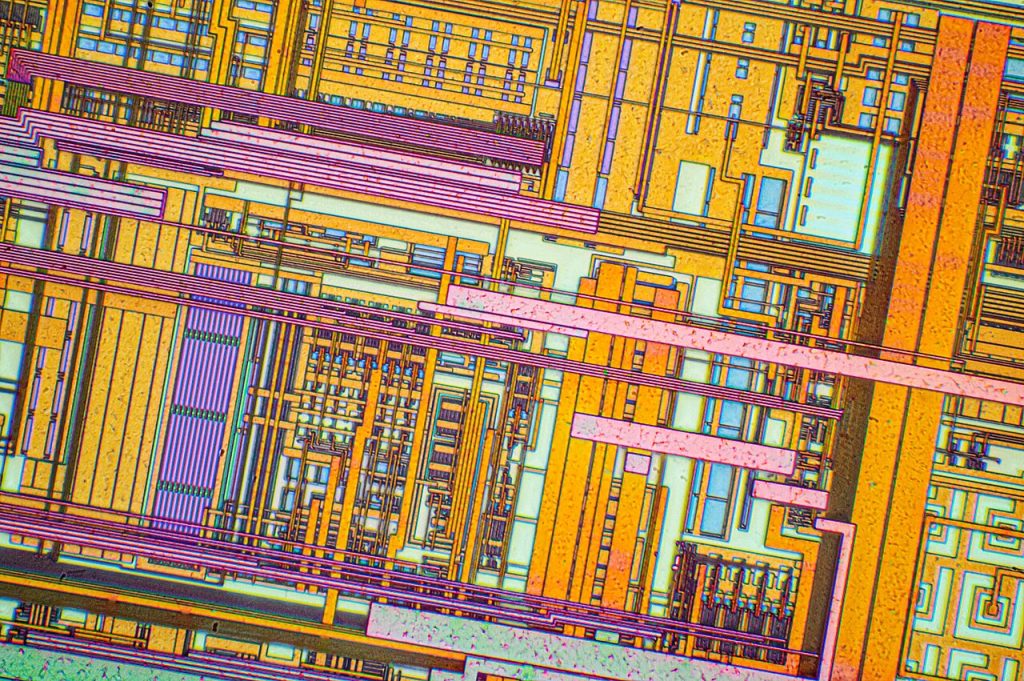
Image credit: Original: Alexander Klepnev
Derivative work: IamMM via Wikimedia Commons (CC BY-SA 4.0).