Most people who search for a paris covered passages map want the same thing: a short, rain-proof route that links the best arcades without zigzagging across the 2nd and 9th arrondissements. Good news, the three most atmospheric passages sit almost in a straight line, so you can sketch the map yourself on a napkin.
The mental map: three passages, one afternoon
Picture the Grands Boulevards running east to west. The 19th-century arcades sit just north and south of them, built mainly in the first half of the 1800s, when glass and iron made it possible to roof over a lane and sell things out of the mud and rain. Many were demolished when Haussmann redrew Paris; those that survive are a patchwork of tea rooms, stamp dealers, old bookshops and tiny restaurants.
Your route, north to south, looks like this.
- Passage Jouffroy, entered from Boulevard Montmartre. Built as a continuation of the Panoramas across the boulevard, it’s often described as the first Parisian passage made entirely of metal and glass. Today it holds a wax museum, a bookshop for antique volumes, and a hotel.
- Passage des Panoramas, directly across the boulevard. Dating to around 1800, it’s the oldest of the trio. Its name comes from panoramic paintings once shown here. Look for old engravers and stamp shops, plus a crowd of small restaurants.
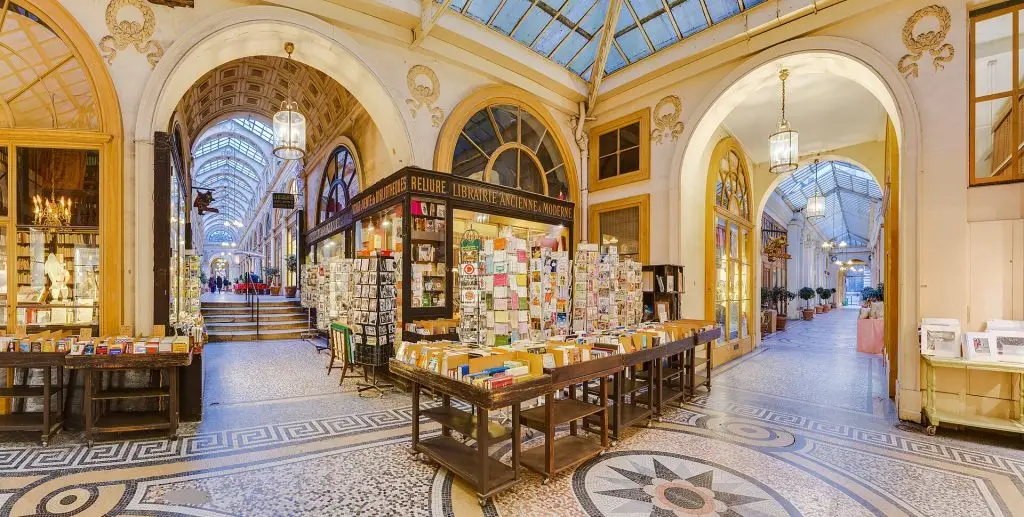
- Galerie Vivienne, a ten-minute walk west and south. Opened in the mid-1820s (sources give dates between 1823 and 1826), it has a mosaic floor, a rotunda and a wine shop that has been there for ages. It’s the polished one.
Sources disagree on exact opening years for several passages, so treat dates as approximate and check the city’s own heritage pages if you want precision.
Linking them on foot
Start at the Grands Boulevards metro stop, cross into Jouffroy, come out the other end on Rue de la Grange-Batelière, then loop back through Panoramas. From there walk toward the Palais-Royal side, where Galerie Vivienne has entrances on Rue des Petits-Champs and Rue Vivienne. Allow about two to three hours with a coffee stop.
Adding extras to your paris covered passages map
If you’ve got energy left, add a few more stops.
- Galerie Colbert, next door to Vivienne, now part of the national library’s art institute. It’s worth a peek at the rotunda.
- Passage du Grand-Cerf, further east near Rue Montorgueil, with a tall glass roof and craft studios. Brighter and more modern in feel.
- Passage Brady, in the 10th, known for its Indian and Pakistani restaurants. Different mood, different century of Paris.
Practical advice
- Opening hours vary by passage and many gates close in the evening or on Sundays. Check each passage’s current hours before you go, since they change.
- Weekday mornings are calm. By Saturday afternoon the cafés fill and photography gets tricky.
- These are real streets with real shops, so go in for lunch rather than just taking pictures. Look at the menu board before sitting down.
- Rain is actually ideal. You’ll walk almost the entire route under glass.
Which passage if you only have an hour?
Galerie Vivienne. It has the best floor, the most graceful proportions and an easy tea-room break. If you’ve got a second hour, add Jouffroy and Panoramas, which are livelier and a bit shabbier in a good way.
A quick note on reading maps
Google Maps often hides the smaller entrances, because passages are labelled inconsistently or not at all. Search by name, then zoom in until you can see the narrow gap in the building line. Printed tourist maps tend to mark only the biggest ones. The city of Paris publishes a heritage guide to its galleries and passages on paris.fr, and it’s a decent reference if you want a plan that matches opening times.
For the history, including which passages were lost and which were restored, the Covered passages of Paris on Wikipedia gives a good overview with a list of surviving arcades.
Sample half-day plan
- 10:00 Grands Boulevards metro, coffee near Passage Jouffroy.
- 10:30 Walk Jouffroy and browse the bookshop.
- 11:15 Cross to Panoramas, look at the old printers and ticket-sellers.
- 12:30 Lunch in a passage restaurant, ideally a short menu of the day.
- 14:00 Stroll to Galerie Vivienne and Galerie Colbert.
- 15:30 Finish in the Palais-Royal gardens.
Common mistakes
The usual trap with any paris covered passages map is treating the passages as museums. They’re working arcades, and some have shuttered shopfronts on Sundays or Mondays. Another is starting too late: by early evening several gates are locked. Finally, don’t try to tick off all twenty-odd surviving passages in one go. Pick three or four, linger, and come back another day for the rest. A relaxed pace beats a long list, and the quieter side passages often give you the best photos without anyone in the frame.
Eating along the route
The Panoramas area is full of small restaurants with fixed lunch menus, while Galerie Vivienne has tea rooms and a well-known wine shop. For something quicker, grab a sandwich from a bakery on the surrounding streets and eat it in the Palais-Royal gardens. Check menus and hours at the door.
That’s the whole thing. No ticket, no booking, just a pair of comfortable shoes and a willingness to look up at the roofs.
Related reading: Amsterdam Straßen: Namen, Grachten und Orientierung and Voorburg: The Roman Town Beside The Hague