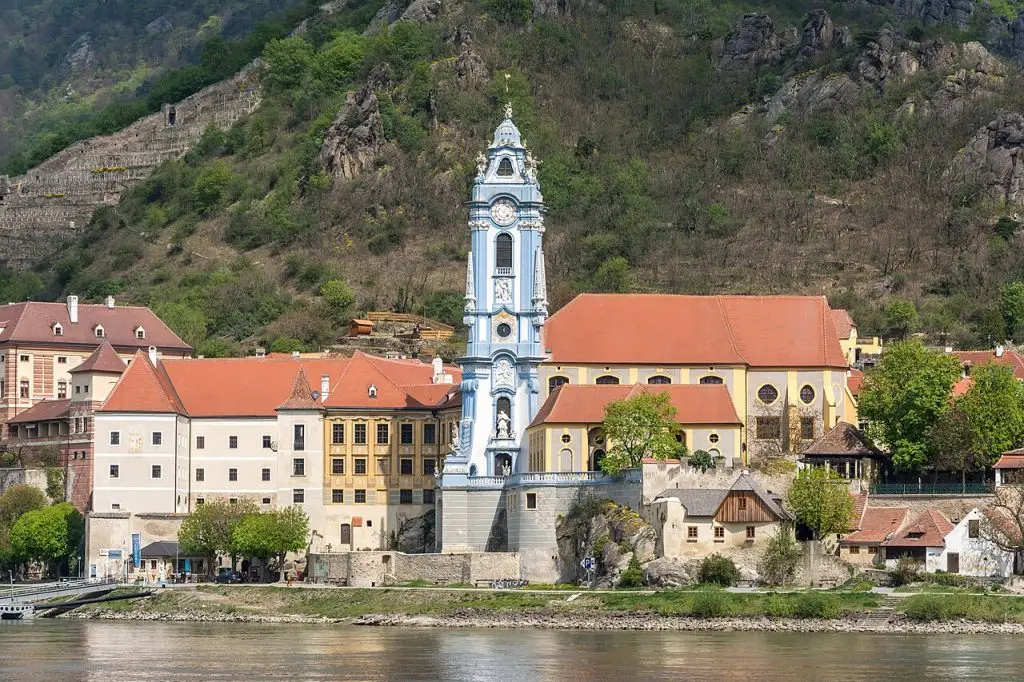
Durnstein is a small village on the Danube in Austria’s Wachau valley, and it is one of the most photographed places in the country. A pale blue baroque church tower rises above a tight huddle of old houses, vineyards climb the slopes behind, and ruins crown the ridge. It is easy to reach from Vienna, small enough to see in a few hours, and good for wine, walking and a slow lunch. This guide covers the sights, the history, and the practical details.
Why Durnstein Is Famous
The village sits on the left bank of the Danube, about 70 kilometres or so west of Vienna, in a landscape recognised as a UNESCO World Heritage site, the Wachau Cultural Landscape. The valley is shaped by terraced vineyards, apricot orchards, medieval towns and monasteries. Durnstein is its postcard stop, thanks to the abbey church and the castle ruins above.
The Blue Tower
The most recognisable sight is the baroque tower of the former Augustinian canons’ abbey, painted blue and white, which stands out against the green hills. The abbey was founded in the Middle Ages, and the present church dates mainly from the 18th century. Visitors can usually enter the church and, in season, walk through the abbey’s courtyard. Opening times vary, so check ahead.
The Castle Ruins and Richard the Lionheart
Above the village are the ruins of Kuenringer castle. The story attached to them is a famous one: Richard the Lionheart of England, returning from the Third Crusade, was captured near Vienna in 1192 and held by Duke Leopold V of Austria. According to tradition, he was imprisoned in the castle at Durnstein. The legend of his faithful minstrel finding him by song is a later romantic tale and should not be treated as historical fact.
The Hike
The walk up to the ruins takes roughly 20 to 30 minutes on a steep path, which starts at the edge of the village. Wear sturdy shoes and bring water. The reward is a broad view over the Danube, the vineyards and the rooftops. Entry to the ruins usually requires a small fee in season, and the site may close in winter or in poor weather. Verify the arrangements before you set out.
Wine and Apricots
The Wachau is known for white wine, above all Grüner Veltliner and Riesling. The local winemakers’ association uses three quality terms you will see on labels: Steinfeder for light, delicate wines, Federspiel for medium-bodied ones, and Smaragd for the richest and ripest. The Smaragd name comes from the emerald lizards that sun themselves on the vineyard walls.
The region is equally famous for its apricots, called Marillen in Austria. The trees bloom in spring, usually late March to April, and the fruit is harvested in July. You can find apricot jam, schnapps, liqueur, ice cream and the traditional Marillenknödel, a sweet dumpling filled with an apricot and rolled in buttered crumbs. Many shops in the village main street sell these products.
- Try a tasting at a local winery, or a glass on a terrace.
- Buy apricot jam or liqueur as a souvenir.
- Order Marillenknödel when the fruit is in season.
Getting There
From Vienna
By train, you can reach Krems an der Donau from Vienna in roughly one hour, with direct regional services. From Krems, a regional bus runs along the river to Durnstein in about twenty to thirty minutes. Check the timetables, because buses are less frequent than trains, especially in the off season. You can also drive, which takes about an hour and a half, depending on the route and traffic, and parking is available near the village for a fee.
By Boat
From spring to autumn, passenger boats operate along the Danube in the Wachau, linking Krems, Durnstein, Melk and other stops. The boat ride is slow but scenic, so it is a good option if you have time. Check the operator’s website for the current timetable and prices.
By Bike
The Danube Cycle Path (Donauradweg) passes through the village. Cycling the Wachau is popular, with flat stretches and many rest points. You can hire a bike in Krems or Melk and ride one way, returning by train or boat. Check rental terms for one-way returns.
When to Visit
Spring is ideal for apricot blossom and mild weather. Summer is warm, and the village gets busy with tour groups in the middle of the day, so go early or stay until the evening. Autumn brings the grape harvest and golden vineyards, and it is a lovely time for a walk. Winter is quiet; some shops and restaurants close, so check before going.
Where to Eat and Stay
The village has small hotels, guesthouses and wine taverns known as Heurigen or Buschenschank, which serve local wine with simple food such as cold cuts, cheese and bread. Some places open only on certain days, and reservations are advisable in the high season. For a bigger choice of accommodation, consider staying in Krems or Melk and visiting Durnstein for the day.
Combining Durnstein With Other Stops
A good day plan could begin in Melk with its monumental abbey, continue by boat to Durnstein for lunch and the castle hike, and end in Krems with its old town before taking the train back to Vienna. Another option is to cycle the stretch between Melk and Krems and stop in the villages of Spitz, Weissenkirchen and Durnstein along the way.
Practical Tips
- Wear comfortable shoes for steep paths and cobbled lanes.
- Bring a layer for the evening, since the river valley can be cool.
- Carry some cash, because small taverns and shops do not always accept cards.
- If you plan to taste wine, avoid driving afterwards. Use public transport or a taxi.
For historical and visitor background, see the Durnstein article on Wikipedia. Opening times, ticket prices and timetables change, so confirm them with the official sources of the local tourism board and transport operators before you go.
Final Thoughts
Durnstein packs a lot into a small space: a landmark tower, a castle legend, excellent wine, and apricot desserts that are worth the trip alone. It is easy to see as a day trip from Vienna, but a night in the valley lets you enjoy it when the tour groups have left. Plan around the seasons, bring good shoes, and take your time.
More to read
Image credit: Uoaei1 via Wikimedia Commons (CC BY-SA 3.0).