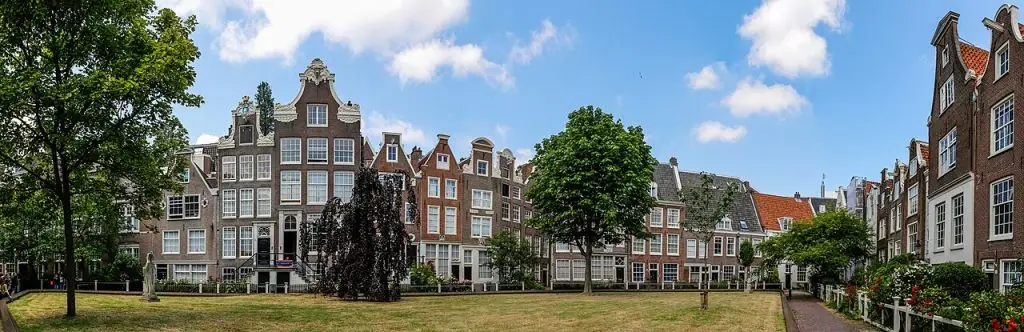
The Begijnhof in Amsterdam is a small, quiet courtyard of historic houses just off the busy Spui square, a few steps from shopping streets and trams. Many people walk past the entrance without noticing it. This guide explains what it is, what to see inside, how to behave, and how to fit it into a day in the centre. (There are other begijnhofs in Belgium and the Netherlands, for example in Leuven and Bruges; here I mean the Amsterdam one.)
What is a Begijnhof?
A begijnhof is a closed community built for beguines, lay religious women who lived together in prayer and charity without taking formal vows as nuns. They appeared in the Low Countries in the Middle Ages. The Amsterdam site dates back to the 14th century, and its houses were built around a central green. Today it is a residential courtyard, and people still live there, which is why visitors are asked to be quiet and respectful.
How to find the entrance
The entrance is a small gateway on the Spui, between shops, and you walk through a passage into the courtyard. Because the entrance is hidden, keep an eye out for a small sign. Once inside, the noise of the city fades quickly, which is the whole point of visiting.
What to see in the Begijnhof
The Houten Huys
One of the oldest houses in Amsterdam is the Houten Huys, the wooden house. Wooden fronts were banned in the city for fire safety after serious fires, so this house stands as a rare survivor. Its exact age is often dated to the 16th century, though details differ between sources. You see it from outside only, since it is a private home.
The English Reformed Church
Right in the middle of the courtyard stands the English Reformed Church, which has been used by an English-speaking congregation since the 17th century. After the Reformation, Catholic worship was prohibited publicly in Amsterdam, so the beguines’ own chapel was repurposed. Visitors can usually go inside at certain times, but services and events affect access, so check the church’s website.
The Catholic chapel
The Catholic chapel, set in an ordinary-looking house on the courtyard, was built as a hidden church in the 17th century, when Catholics were not allowed to hold public services. It has a link to the legend of the Miracle of Amsterdam. It is a modest but meaningful place, and visitors can often enter. Opening hours vary, so look them up on the official site.
Doorway plaques and gables
Take time to look up. Stone tablets on the facades show biblical scenes and symbols, a reminder of the religious life of the place. The gables differ from house to house, and small gardens at the front give the courtyard a calm, village feel.
Visiting etiquette
- Keep your voice low. This is a home for residents, not a stage.
- Do not enter private doors or gardens. Stay on public paths.
- Be careful with photos. Photographing buildings is generally fine, but do not photograph residents without asking, and do not use drones or tripods that block the way.
- No tour groups blocking the path. If you are with a guide, follow current rules on group sizes.
- Follow the signs. Rules are posted at the entrance, and they may change.
Opening hours and cost
The courtyard is usually open to the public during the day, with free entry. Hours and access rules can change, especially around holidays and events, so check the official Amsterdam tourism website or the church’s page for current information as of 2025/2026. Some chapel or church visits have separate times.
How to get there
It is in the old centre, about a 10 to 15 minute walk from Dam Square and 15 to 20 minutes from Amsterdam Centraal. Trams stop at Spui or nearby Koningsplein, and you can walk from the Rijksmuseum area in about 20 minutes. The area is flat and walkable, though there are cobbles.
What to combine it with
- Spui book market: On Fridays there is a book market on the square, and on Sundays an art market. Check the current schedule.
- Amsterdam Museum: The city history museum is located nearby. It is a good pairing if you want context about the era.
- Kalverstraat and Singel: Shopping and a canal walk are close at hand.
- Café stop: The area has many places for coffee and apple pie.
How long to allow
Twenty to forty minutes is enough to see the courtyard, the church and the Houten Huys. If you read the plaques and sit for a moment on a bench, it will take longer. Many people go first thing in the morning when the courtyard is empty. In summer, afternoons are busier, and the courtyard feels most peaceful in the first hours after opening.
Why the Begijnhof is worth your time
Amsterdam is busy, and the Begijnhof offers something rare: a pause. It shows an older side of the city that does not rely on museums or boats. For more official information on sights and visiting, see iamsterdam.com. If you only have an hour spare in the centre, spend part of it in the Begijnhof.
Photo: Dietmar Rabich, CC BY-SA 4.0, source.