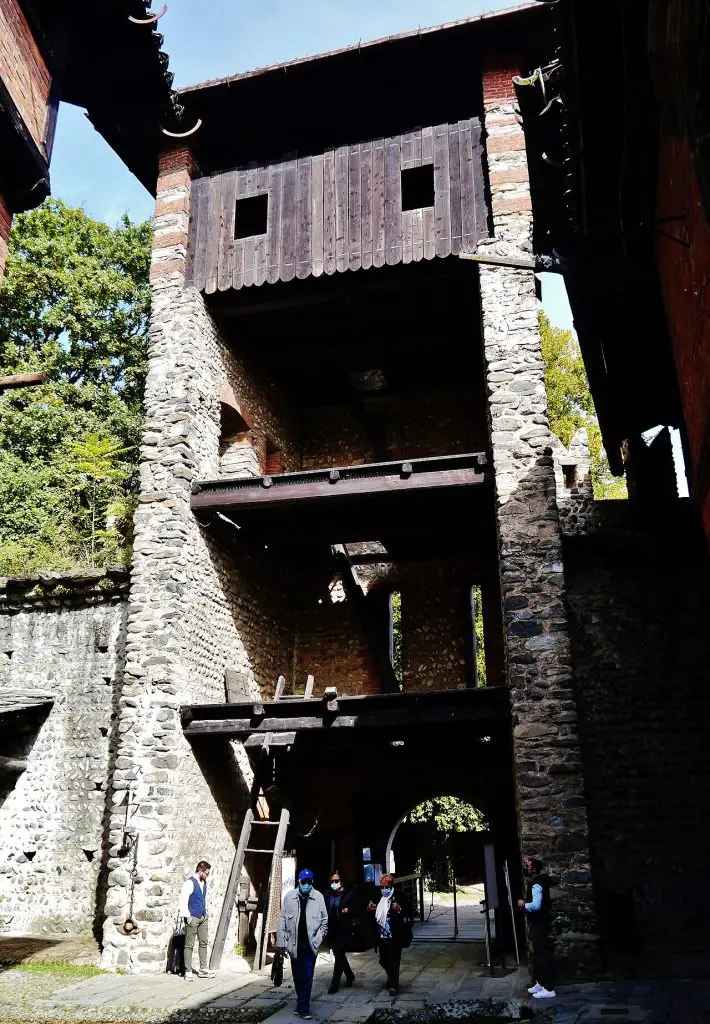
The village médiéval Turin travellers ask about is the Borgo Medievale, a medieval-style village and castle on the bank of the Po inside the Parco del Valentino. It looks like a 15th-century Piedmontese settlement, but it was built for the Italian General Exposition of 1884. It is a very good fake, and that is part of the charm.
One important warning before you plan a visit: the Turismo Torino website has stated that the Rocca and Borgo Medievale would be closed for restoration works from 1 January 2024 until 2027, while another listing suggested a different reopening date. I could not confirm the current status as of today, so check the official museum pages before you go. If it is closed, the park and the riverside walk are still lovely.
What the village médiéval Turin really is
The designers, led by the architect Alfredo d’Andrade, did not invent a fantasy. They studied real castles, houses, churches and fortifications from Piedmont and the Aosta Valley and reproduced them stone by stone in Turin. So you get a composite: a lower village with workshops, a gate, a church and a square, and above it a stronghold, the Rocca, modelled on a Valle d’Aosta castle. For historians of the 19th-century medieval revival, this is a landmark.
That is why the place makes an interesting contrast with the rest of Turin. The city is known for Baroque palaces, arcades and the Savoy residences. The village médiéval Turin has in the park is a different, more playful idea of history, closer to what the Victorians imagined the Middle Ages should look like.
What you can see
As reported by tourist-office sources, the lower village is free to walk into, while the castle and its garden require a ticket. Typical highlights, when open, are:
- The village streets with artisan workshops, sometimes with demonstrations of traditional crafts.
- The Rocca (castle) with decorated rooms, fireplaces, furniture and frescoes made in the late medieval style.
- The medieval garden with herbs and plants typical of the period.
- The views over the river and across to the hills of Turin.
Opening times, ticket prices, and which areas are accessible vary and change with restoration work. One listing gives longer opening hours in summer than winter, but I would not rely on it. The official pages of the Turin civic museums have the current schedule.
Getting there and pairing it with the rest of the day
The village sits inside Parco del Valentino, the big riverside park near the Valentino Castle and the botanical garden. The address is Viale Virgilio 107. From the centre it is a pleasant walk along the Po from Piazza Vittorio Veneto or a short ride by city bus or tram; check GTT for current routes. The Porta Nuova station is also within reach by public transport.
If you are putting together a day, here is a loose plan that works:
- Morning: walk through the park and have a look at the Valentino Castle exterior.
- Late morning: the Borgo Medievale, if open, with the castle visit.
- Lunch: a trattoria in San Salvario, the lively neighbourhood a short walk away.
- Afternoon: the Egyptian Museum or the Mole Antonelliana back in the centre.
Who will like it
Families enjoy it because children can run around a village with towers, and photographers like it in the late afternoon when the stone turns golden. Purists who only want genuine medieval fabric may be underwhelmed, so go in knowing it is a replica. Accessibility is limited by steep paths and cobbles; one visitor account calls it not very wheelchair friendly, so ask the museum if that matters.
A bit of background on 1884
The Italian General Exposition of 1884 was a showcase for a country that had only been unified a couple of decades earlier. Turin, the first capital of the new kingdom, wanted to present Piedmont’s heritage next to its industry and science. A medieval village was the heritage part: a way of saying that the region had deep roots. After the fair, the village was kept instead of being torn down, which is why it still stands today and is run as part of the city’s museums.
Inside the castle, much of the furniture and decoration is also period-style rather than genuine, though some pieces are authentic or copied from originals. Guides and labels on site explain which is which, and that honesty makes the visit more interesting rather than less. Think of it as an open-air museum of how the 19th century understood the 15th.
Tips if you visit the village médiéval Turin offers
- Check opening status first. Restoration work has been announced, and dates have shifted.
- Wear sturdy shoes. The streets are cobbled and uneven.
- Bring a camera, but expect to ask about photo rules indoors.
- Combine it with the Valentino Castle exterior and the park walk so a closure of one part does not ruin the day.
In short, the village médiéval Turin has to offer is an architectural curiosity, a lovely park setting, and a good half-day, provided the restoration has finished. Verify the status on the official Turin museum site first.
Related reading: New York Times Square Hotels With a View: How to Choose · Winter Park Florida: Park Avenue, Lakes and Tiffany Glass