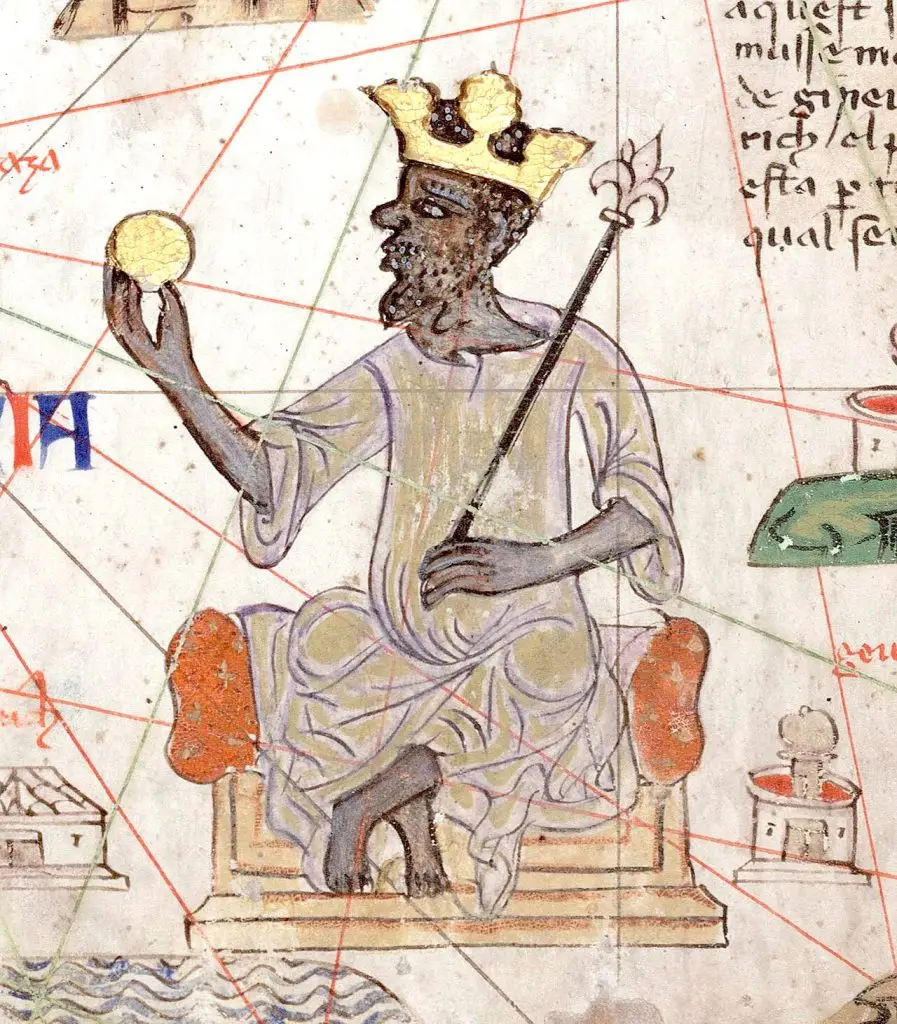
Mansa Musa often tops lists of the richest people who ever lived, and a popular figure of four hundred billion dollars is repeated across the internet. The honest answer to what was the networth of mansa musa is more interesting: historians agree he was extraordinarily wealthy, but they also say that his fortune cannot be turned into a modern dollar figure with any confidence.
Who he was
Musa I ruled the Mali Empire in West Africa from about 1312 until about 1337. The empire controlled rich gold-producing regions and important trade routes across the Sahara, including the trade in salt, which was valuable in the region. Under his rule Mali became one of the most powerful states in the world of its time, with cities such as Timbuktu and Gao growing into centres of trade and learning.
The pilgrimage that made him famous
In 1324 he made a pilgrimage to Mecca, travelling through Cairo with a vast retinue. Contemporary and later Arabic sources describe a huge caravan, with thousands of attendants and large amounts of gold, which he distributed generously along the way. Writers in Cairo recorded that so much gold arrived that its value fell in the city for years afterwards, though the details vary between accounts. The story spread across the Mediterranean and even appeared on a European map, the Catalan Atlas of 1375, which shows a king holding a gold nugget.
Where the four-hundred-billion figure comes from
The figure is usually traced to a 2012 online list of the richest people in history that estimated his wealth at four hundred billion dollars in modern terms. The authors of such lists say themselves that it is a guess. Many historians dispute the method, because they point out that there was no way to measure wealth then in the way we do now.
Why the networth of mansa musa cannot be calculated
- No accounts. No surviving documents list the empire’s gold, land or income.
- Personal versus state wealth. A ruler’s treasury and a person’s net worth are different things, and in a medieval empire the line was blurry.
- Prices over centuries. There is no reliable conversion between fourteenth-century gold and today’s money, and gold’s purchasing power changed constantly.
- Sources are indirect. Most accounts were written by visitors or by writers who heard stories years later.
What can be said with some confidence
The Mali Empire was a major producer of gold, and by some estimates supplied a large share of the gold used in the Old World at the time. Musa’s wealth came from taxing trade and controlling gold supply, and he spent part of it on mosques, scholars and buildings, including the Djinguereber mosque in Timbuktu. After his return, he brought scholars and architects to Mali, which strengthened its role in education.
How to write about it responsibly
- Say “often described as the richest person in history”.
- If you quote the four hundred billion figure, attribute it and say it is a rough modern estimate.
- Mention that historians doubt such conversions.
Other candidates for richest ever
Lists often include Augustus Caesar, the Song dynasty emperors, Akbar the Great, the Rothschild family and John D. Rockefeller. Each had wealth that is hard to compare, and most historians prefer to describe them in terms of the share of their economy they controlled, not in modern dollars.
Our guide on who has the highest net worth in the world today covers the modern lists, and the article on finding net worth from public sources explains why method matters. The British Museum and other institutions have material on the Mali Empire, such as Britannica’s entry on Mansa Musa.
What his story teaches about wealth and trade
Beyond the headline number, the story of Mali shows how wealth depended on control of routes and resources. Gold from West Africa and salt from the Sahara moved along caravan roads, and the empire taxed the trade. Musa’s generosity during his pilgrimage also shows how a ruler could use wealth for influence, and it reveals the limits of treating any single person’s riches as a simple number. Economic historians now study Mali’s role in a wider network connecting the Mediterranean, the Middle East and West Africa.
Where to read more
For a serious look, read the translated accounts by the Arab travellers and scholars who wrote about Mali, such as Ibn Battuta and Ibn Khaldun, whose descriptions come decades later, and modern work by historians of West Africa. Museums and university libraries often have introductions suitable for general readers, and they treat the fortune with the caution it deserves.
The short answer
As for what was the networth of mansa musa, popular lists say four hundred billion dollars, but historians say it cannot be priced. What is certain is that he ruled one of the richest empires of his time and left a lasting mark.
Figures are popular estimates and are not verified historical facts. This is general information, not financial advice.