What is networth of company? In plain terms, it is what would be left for the owners if the business sold everything it owns and paid everything it owes. Accountants usually call that shareholders’ equity, or book value, and it sits at the bottom of the balance sheet. It is not the same as what the company would fetch if sold, which is a different and often larger number.
Table of Contents
The basic formula
Total assets minus total liabilities equals net worth, which in a company is called equity. Assets include cash, inventory, equipment, property, money customers owe and investments. Liabilities include bank loans, bonds, supplier bills, taxes owed and other obligations. The result tells you how much of the company’s resources belong to the owners rather than creditors.
Where to find what is networth of company in the accounts
For a listed company, the balance sheet in its annual report shows total shareholders’ equity, usually near the bottom. In the United States, public companies file these reports with the Securities and Exchange Commission, and you can read them for free on its EDGAR database. For a private company, the figure sits in its own accounts, which only owners, lenders and sometimes tax authorities see.
Book value versus market value
This is the distinction that causes the most confusion when people ask what is networth of company.
Book value
This is the accounting number, based on historical costs and rules. A building bought thirty years ago may appear at a low depreciated value, even if it is worth much more today.
Market value
For a listed company, market capitalization is the share price multiplied by the number of shares. It reflects what investors collectively expect about the company’s future profits, not just its past balance sheet. A technology company with few physical assets may have a market value many times its book value.
Enterprise value
Analysts also use enterprise value, which adds debt to market capitalization and subtracts cash. It estimates what it would cost to buy the whole business.
A simple worked example
Imagine a small bakery with equipment worth forty thousand, cash of ten thousand, inventory of five thousand and money owed by customers of three thousand. Its assets total fifty-eight thousand. It owes twenty thousand on an equipment loan and four thousand to suppliers. Liabilities total twenty-four thousand. Net worth is thirty-four thousand. If the bakery had a loyal customer base and a good location, an outside buyer might pay far more than thirty-four thousand, because buyers pay for future earnings, not just the equipment.
Why a company’s net worth can be negative
Some firms have negative equity, meaning liabilities exceed assets. That can happen after years of losses, or when a company has bought back many shares using debt. It is not always a sign of failure. Some profitable companies carry negative book equity because of large buybacks. Context matters, which is why analysts look at cash flow and debt levels alongside the equity figure.
Reading a real balance sheet
Open any annual report and the balance sheet is organized in a consistent way. Current assets come first: cash, short-term investments, receivables and inventory. Then come long-term assets such as property, equipment and intangible assets like goodwill, which arises when a company buys another for more than the value of its identifiable assets. On the other side are current liabilities, due within a year, and long-term liabilities such as bonds. Equity includes the money shareholders paid in, plus retained earnings, which are profits kept in the business rather than paid out as dividends.
When you ask what is networth of company for a business with a lot of goodwill, remember that goodwill can be written down if an acquisition goes badly, which reduces equity overnight. Analysts sometimes look at tangible book value, which removes goodwill and other intangibles, to get a more conservative picture.
Why it matters
- Lenders look at equity as a cushion against losses.
- Investors compare share price with book value per share.
- Owners use it to track whether the business is building value.
- Buyers use it as a starting point for negotiation.
How it relates to personal net worth
The idea is the same as for a person: assets minus liabilities. If you own part of a company, its equity is one input to your own balance sheet, though valuing a private stake is hard. For the personal version of the calculation, read our guide on how to calculate net worth and our short note on what net worth is based on.
Common mistakes
- Treating market capitalization as net worth. They measure different things.
- Ignoring off-balance-sheet obligations, such as certain leases or guarantees.
- Assuming book value reflects true replacement cost.
- Comparing companies in different industries using equity alone.
A reference for definitions
The Investopedia entry on shareholders’ equity gives a clear definition, and annual reports show real examples.
In short, what is networth of company is a balance sheet figure, assets minus liabilities, which tells you the owners’ accounting stake and not necessarily the price someone would pay. This article is educational and is not investment or accounting advice.
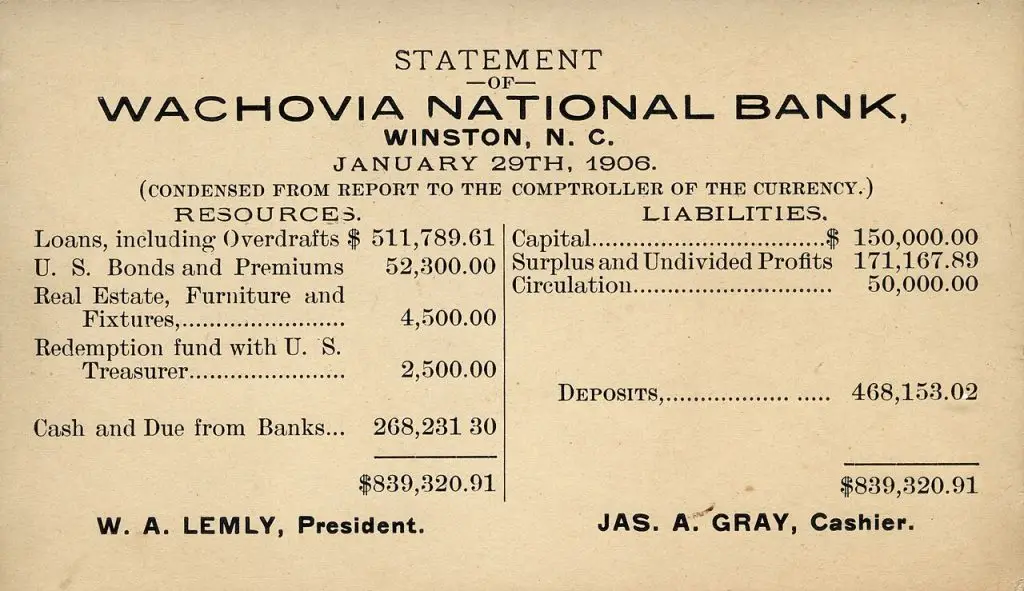
Featured image: Wachovia National Bank 1906 statement.jpg by Wachovia National Bank, Winston, NC, Public domain, via Wikimedia Commons.