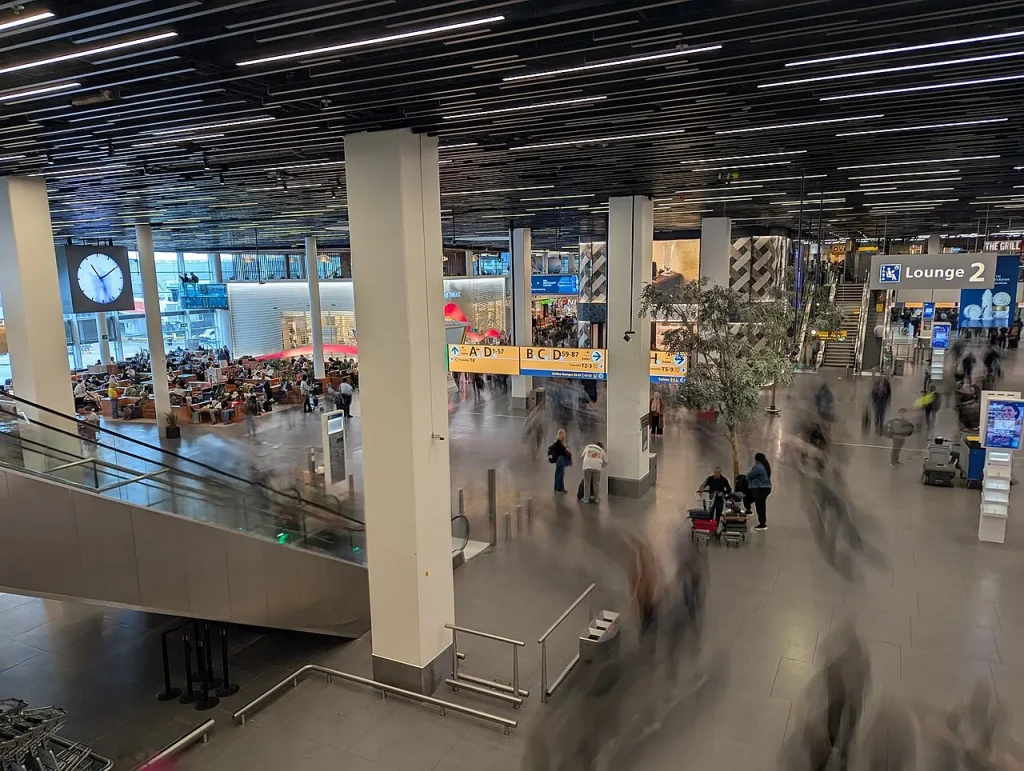
A Schiphol airport map looks scarier than the airport really is. Strip away the colored zones and the arrows, and what you have is one big terminal building under a single roof, a train station tucked underneath it, and a handful of long piers where the gates sit. Once you hold that picture in your head, you can find almost anything without staring at your phone.
The short version of the Schiphol airport map
Schiphol, which lies southwest of Amsterdam in the Haarlemmermeer polder, is built as one connected terminal rather than several separate ones. Arrivals, departures, shops, restaurants and the railway station are all inside the same complex. You never need a bus to go from one terminal to another, which is a relief if you have flown through airports where that is the norm.
The building is split into three departure halls, numbered 1, 2 and 3, that feed into the same security area. Which hall you use mostly affects where you check in and drop bags. After security, the halls flow together and the real navigation starts, because the gates are spread out along piers lettered B, C, D, E, F, G and H.
Schengen or non-Schengen: the line that matters most
If you only learn one thing from the map, learn this. The airport is divided into a Schengen side and a non-Schengen side, and passport control sits between them. Flights within the Schengen area, which covers most of continental Europe, leave from one set of piers. Flights to the United Kingdom, the United States, Asia and most other places leave from the other set.
Your boarding pass shows the gate letter, and that letter tells you which side you are on. Walking time between the far ends can be considerable, often twenty minutes or more at a normal pace, so do not treat the two sides as neighbors. If you have a connection, work out in advance whether you cross the passport line, because that is where queues form.
A quick guide to the piers
- B, C and D: mainly Schengen flights, with a large share of the airline traffic within Europe.
- E, F and G: mainly non-Schengen flights, including long-haul departures.
- H and M: smaller extensions that you will only see if your gate is assigned there. Check the screens, since gate allocations can change.
These groupings shift over time as the airport rearranges its operations, so treat them as a rough guide and confirm with the current airport map or your airline app.
Landside: where you go before security
The public area at the front of the airport is called Schiphol Plaza. It is the place where the railway station, the bus stops, the taxi ranks and a big supermarket all meet. If you arrive by train, you step out of the lift or escalator straight into the hall. Trains to Amsterdam Centraal take roughly fifteen to twenty minutes, and there are also direct services to cities such as Leiden, Den Haag, Utrecht and Rotterdam, though routes change, so check the current timetable.
Plaza is also the best spot to meet someone who is collecting you. Arrivals halls open into it, and it has plenty of seating. If you are picking up a friend, agree on a specific meeting point, because the area is bigger than it first appears.
Airside: what is behind security
After the security check, the main shopping street leads you toward the piers. This stretch has the larger duty-free store, bakeries, bars, and a surprising little branch of the Rijksmuseum, which shows a small rotating selection of Dutch paintings. It is free to look at from the walkway, which makes it a nice way to burn twenty minutes. There is also a small library with books by Dutch authors, and quiet corners with charging points.
Food options spread out along the piers. If you are choosing where to eat, do it before the long walk to a distant gate rather than after, since the hungry middle of the pier can be a bit thin on choices. For the full story on the airport itself, the Amsterdam Airport Schiphol article gives the background and history.
Practical tips for using a Schiphol airport map
- Download the airport app or save the map offline. Terminal wifi is usually decent, but a saved copy saves you in crowded moments.
- Note your gate letter first. The letter tells you the direction and which passport zone you need.
- Leave a buffer for security and passport control. Queues vary a lot, especially in the morning and early afternoon waves.
- Follow the colored ceiling signs. They are consistent and clearer than most people expect.
- Ask staff. Staff in yellow and blue tend to be patient and speak good English.
Connecting through Schiphol
Transfers are usually straightforward. If you stay airside, follow the transfer signs and keep the same boarding pass logic in mind: Schengen or not. If you need to switch airlines on separate tickets, you will probably have to leave the secure area, collect your bags, and check in again, which takes much longer. Give yourself generous time and double check the rules for your own ticket.
Finally, if you have a long layover and want to see something, the train makes a short city trip possible. Amsterdam is close, and so is the pretty town of Haarlem, which has a lovely old center. Only do this with a big margin, though, and keep an eye on border control and security timing on your way back. A calm approach and a basic understanding of the layout will get you through nearly any day at Schiphol.
More from us: Travel Tips.
Featured photo: Sdkb / Wikimedia Commons (CC BY-SA 4.0).