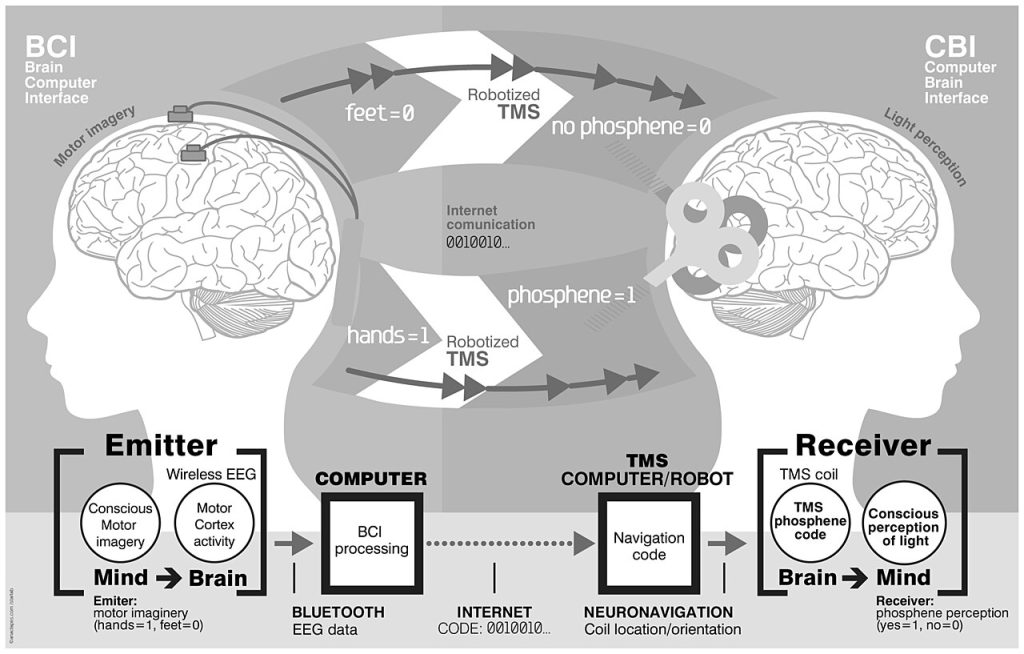
A brain-computer interface, or BCI, is a system that links the brain to an external device. It sounds like science fiction, but researchers have been developing the technology for decades, and recent years have brought striking demonstrations, including people controlling cursors or communicating with thought-driven systems.
How a BCI works
The brain communicates using electrical activity. Sensors pick up signals associated with intentions, such as the desire to move a hand. Software then decodes the patterns and translates them into commands for a computer, wheelchair or prosthetic arm.
Training is a two-way process. The decoder learns to recognize your patterns, and you learn to produce signals it can interpret reliably.
Invasive and non-invasive approaches
Non-invasive systems use sensors outside the skull, such as electrodes on the scalp. They are safer and easier to use, but the signal is weak and noisy because it passes through bone and tissue.
Invasive systems place electrodes on or inside the brain. They capture far more detailed information, but require surgery and carry risks like infection and scarring. Some designs sit on the brain’s surface; others penetrate the tissue to record from individual neurons.
What has been achieved
Clinical trials have enabled people with severe paralysis to move a computer cursor, type messages and operate robotic limbs with their thoughts. Other research has helped decode attempted speech into text for people who cannot speak. These are early results in small numbers of participants, but they offer hope.
Researchers also explore using stimulation to restore sensation, giving feedback from a prosthetic hand.
The challenges
Longevity is a major concern. Implants must remain stable and safe for years, and the body can react to foreign objects. Signal quality can degrade over time.
Bandwidth matters too. Even advanced systems capture a tiny fraction of what the brain does. Decoding more complex intentions reliably is hard.
Everyday use requires wireless, compact, low-power devices that do not need a team of technicians. Moving from lab prototypes to products involves regulators, manufacturing and cost.
Ethical and privacy questions
Brain data is intensely personal. Who owns it and how it is stored are open questions. Informed consent is vital, especially for participants who may be vulnerable and hopeful. There are also questions about equal access if the technology becomes available, and what happens if a company supporting an implant goes out of business.
Some ethicists call for protections around mental privacy and the right to control one’s own neural data.
Beyond medicine
Some companies envision BCIs for the general public, from gaming to communication. Those ideas are far from reality. For now, the strongest case is in medicine, where the benefits are clear and justify the risks.
Reading news about BCIs
Check whether results come from published, peer-reviewed studies. Notice the number of participants and the duration. Be cautious with claims of near-term mass adoption.
Conclusion
Brain-computer interfaces are advancing steadily, with real benefits for people with severe disabilities. The road to broad use is long, but careful research and thoughtful ethics can ensure the technology develops in ways that help.