
Robo
In this article
t arms are impressive machines, and they’ve been bolted to factory floors for decades. But talk to anyone who has deployed one and they’ll tell you the arm is the easy part. The hard part is getting it to do something useful, reliably, in a messy real-world setting. That’s the territory of robotics software, and it’s where much of the industry’s remaining opportunity sits.
The old way: teach every move
Traditional industrial robots follow scripts. An engineer defines exact positions in space and the robot repeats the motion with great precision. This works wonderfully on a car assembly line where the same part arrives in the same place every few seconds.
It works poorly everywhere else. If the part is slightly shifted, the robot misses. If you change the product, someone has to reprogram the whole sequence. Setting up a new cell can take weeks of specialist time, which is why small and mid-size manufacturers often skip automation altogether.
What makes robotics software so difficult
- Each brand has its own language. Skills don’t transfer neatly between manufacturers.
- Physical uncertainty. Parts vary, grippers slip, and surfaces aren’t perfectly flat.
- Integration. A robot needs to coordinate with cameras, conveyors, sensors, and other machines.
- Safety. Anything that moves heavy objects near people needs careful limits.
- Testing. Trying a new program on a real robot risks damaged equipment.
What a robotics software platform tries to do
A robotics software layer sits between the engineer and the hardware. Instead of writing low-level motion commands, you describe tasks at a higher level, and the platform handles motion planning, collision avoidance, and communication with devices. Good platforms also include simulation, so you can build and test a workflow on a computer before touching the real machine.
The aim is hardware independence. If the same software can run different arms, manufacturers aren’t locked into one vendor, and developers can build reusable skills like picking, placing, inserting, or sanding.
Where AI enters robotics software
Machine learning is helping in a few specific areas:
- Perception. Vision models help robots identify and locate parts that aren’t perfectly placed.
- Grasping. Learned models can predict where to grip an unfamiliar object.
- Learning from demonstration. A person shows the task, and the system generalizes from examples.
- Natural-language instructions. Researchers are exploring ways to describe a task in words and have software turn it into a robot program.
These advances are real, but they come with limits. A model that works 95 percent of the time is impressive in a demo and unacceptable on a production line that needs far higher reliability. Industrial customers care about uptime and predictability more than novelty.
Why corporate backing matters
Robotics software demands long development cycles and patient funding. Teams need access to real robots, factories to test in, and strong computing resources for training and simulation. Being part of a large technology company can provide that, along with access to AI research. The trade-off is that products must justify their place within a bigger organization’s priorities.
What to look for in robotics software
- Support for the hardware you already own or plan to buy.
- A quality simulation tool that matches real behavior closely.
- Clear safety features and documentation.
- An ecosystem of reusable skills and partner integrations.
- Honest metrics from real deployments, not only demos.
Looking ahead
The big shift isn’t a humanoid robot walking out of a lab. It’s quieter. As robotics software gets easier, more factories, warehouses, and workshops can afford to automate tasks they couldn’t before. The robot becomes less of a specialist machine and more of a tool a trained technician can redeploy. That change is slow, but it’s the kind that adds up. The companies that make robot programming feel closer to ordinary software work stand to shape how the whole field grows.
Testing in the real world
A robot that performs flawlessly in a lab can still struggle on a factory floor. Lighting changes, parts arrive slightly misaligned, a box is a little crushed, or a worker walks through the workspace. Robotics software has to handle all of that without stopping the line or putting anyone at risk, which is why testing takes up so much of a project.
Teams often build a simulated version of the workcell first, so they can run thousands of attempts without damaging equipment. The simulation never matches reality perfectly, though, so engineers then refine behavior on the actual machine, usually at reduced speed. Safety checks, such as limiting force and stopping when a person gets close, are tested separately and repeatedly.
This slow, careful process explains why robot deployments often take longer than the demonstration videos suggest. Good robotics software makes it easier to move between simulation and the real machine, and to record what went wrong so the same mistake is not repeated.
Why robotics software keeps evolving
The field is changing because the pieces around it are improving. Cameras are cheaper, simulators are more realistic, and general-purpose AI systems are starting to help with planning. Our explainer on general-purpose AI agents describes the kind of software that may eventually sit above the robot controller and turn a request into a sequence of steps.
Even so, robotics software has to meet a standard that chat programs never face. If a chatbot is wrong, you rewrite the question. If a robot is wrong, a part is scrapped or a machine is damaged. That gap explains why progress feels slower than the demos suggest, and why the sector rewards teams that are patient about testing.
For background on the machines themselves, the article on the industrial robot covers their history and common designs. Better robotics software is what turns that hardware from a fixed tool into a flexible one.
A practical example
Picture a small metal shop that wants a robot to load parts into a machine. Under the old model, an integrator spends weeks writing code for one part type, and every new part means another round of work. With stronger robotics software, a technician might place a sample part, let a camera locate it, choose a prebuilt pick-and-place skill, and test the whole sequence in simulation that afternoon. The robot hasn’t become smarter in any magical sense. The setup has simply become cheaper, which is what opens the door for smaller shops.
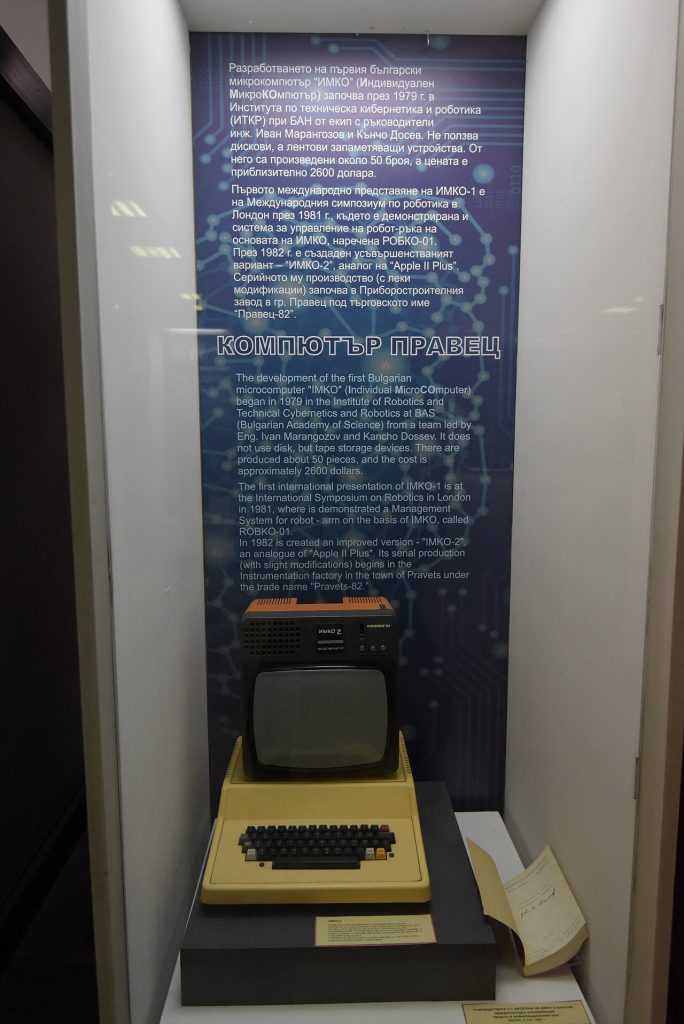
Featured image: ATG – NPTM Photothon 78.jpg by Antonio Georgiev, CC BY-SA 4.0, via Wikimedia Commons.
If you enjoy this side of the industry, our piece on why drone hardware startups shut down shows the same pattern from the other direction: the metal is rarely what decides who survives.



