Watch old footage of astronauts on the Moon and you’ll see something that looks almost comic: people hopping, tipping and struggling to get back up after a fall. The suits were marvels, but they were stiff, and bending a knee took effort. Moon spacesuit design has a harder brief than it seems, because it must be a tiny spacecraft and a piece of clothing at the same time.
What the suit has to do
On the Moon, there is no air to breathe, no pressure to keep body fluids stable, and no protection from temperature swings or fine, sharp dust. The suit supplies breathable gas, holds pressure around the body, manages heat, and shields the wearer from small impacts and radiation. Each of these jobs fights with mobility.

The central trade-off is simple. A pressurized suit is like an inflated balloon. Pressure makes it want to hold a rounded, fixed shape, and bending any joint means squashing the gas inside and working against that pressure. The more pressure, the harder it is to move.
Moon spacesuit design: how joints bend
Engineers use bearings and shaped fabric layers at the shoulders, hips, waist and ankles so those joints can rotate without crushing the gas volume. The aim is to make the volume stay roughly constant as the joint moves, which keeps the force needed low. It’s mechanical cleverness more than raw strength.
The legs deserve special attention. On the Moon, walking, squatting to pick up a rock and climbing out of a shallow crater all involve the hips and knees far more than spacewalks in orbit do, where astronauts mostly use their arms and hands. A lunar suit therefore needs lower body flexibility that older designs didn’t prioritize.
Why fit matters in moon spacesuit design
A poorly fitting suit causes real problems. If it’s too large, the wearer shifts inside and joints don’t line up with the body, so every movement takes more energy. Too small, and pressure points create pain and bruising during hours of work. In training, astronauts have reported that contact points and rubbing can be serious enough to affect performance.
For years, suits were built around a narrow range of body sizes, which meant many people simply couldn’t wear them. Moon spacesuit design for a broader range of people means building adjustable parts: limbs that lengthen or shorten, components that swap in different sizes, and layouts that can be configured for different torsos. This takes more engineering work than one standard size, but it widens the pool of people who can go and makes the system more flexible.
Beyond the basics, a few practical features decide how useful a suit is on the surface.
- Gloves that keep fingers dexterous enough to handle tools and samples
- Boots that grip loose soil and cope with uneven ground
- Dust-resistant joints and seals, since lunar dust is abrasive and clings to everything
- Thermal protection for both sunlit and shadowed areas, which differ dramatically
- A backpack with life support that doesn’t throw the wearer off balance
Gloves are often the weak point. Hands are the most useful part of an astronaut, but they have to be wrapped in layers that hold pressure and insulate, which reduces feel. Small design improvements in glove joints can make a bigger difference to productivity than a lot of flashier changes.
Lower gravity changes the picture. The Moon’s gravity is about one sixth of Earth’s, so a suit and its backpack weigh far less there than at home, but the mass is the same. Starting and stopping a heavy, bulky suit still takes effort. Designers also have to think about balance, because a backpack mounted high can tip the wearer when they lean over to pick something up.
Dust adds a long-term problem. Lunar dust is fine, abrasive and tends to cling, so it can wear seals and bearings over many hours of use. Good moon spacesuit design treats seals as parts that must survive repeated exposure, not a single outing. Remote, harsh-environment hardware is a theme elsewhere, from drifting ocean buoys that gather data far from help to the small modular reactors proposed to power distant sites.
How suits are tested
Moon spacesuit design relies on several kinds of tests. Water immersion pools simulate weightlessness for orbital work. Partial-gravity rigs and suspension systems approximate the Moon’s lower gravity. Vacuum chambers test whether the suit can hold pressure and handle temperature extremes. Field trials in rocky, dusty terrain on Earth reveal practical problems that clean labs miss, like how easily a person can stand up after kneeling.
Human feedback is part of every stage. Subjects of different sizes and abilities try tasks and report what’s awkward, and engineers adjust. Each iteration of moon spacesuit design is slow, because a change in one joint can ripple through the whole design.
What this says about exploration
It’s tempting to think of the big rocket as the hard part of going back to the Moon. In practice, moon spacesuit design is the thing standing between a person and useful work on the surface is a few layers of fabric, bearings and seals. When a suit is comfortable and flexible enough that the wearer can think about science instead of the suit, the mission gets more done. That’s the quiet goal behind all this engineering: make the gear disappear so the work can begin.
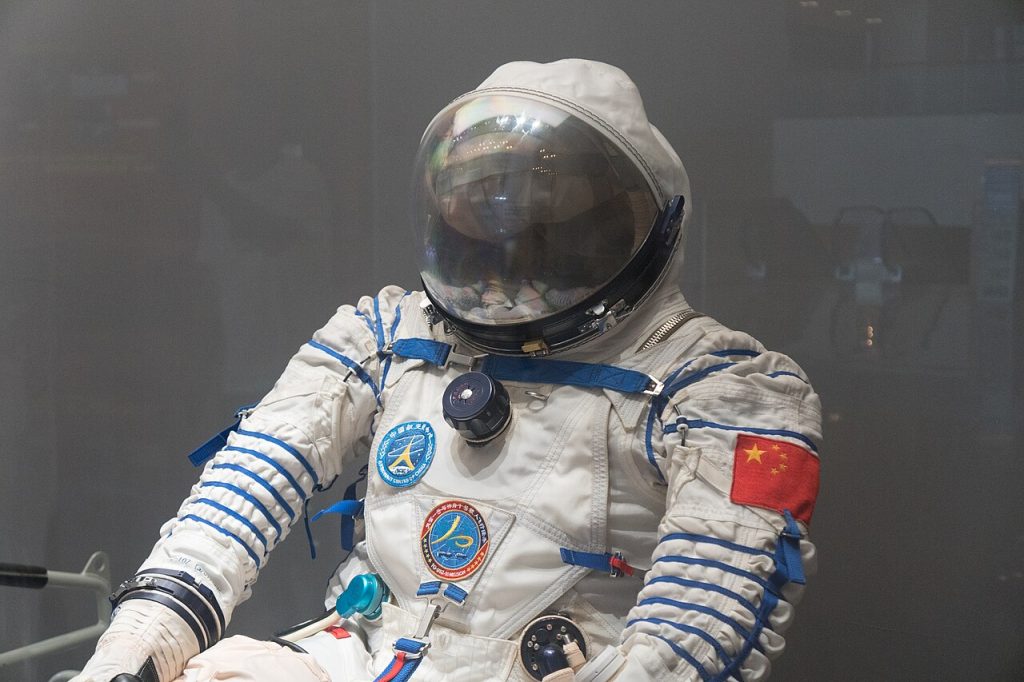
Image: Shujianyang / Wikimedia Commons, CC0.