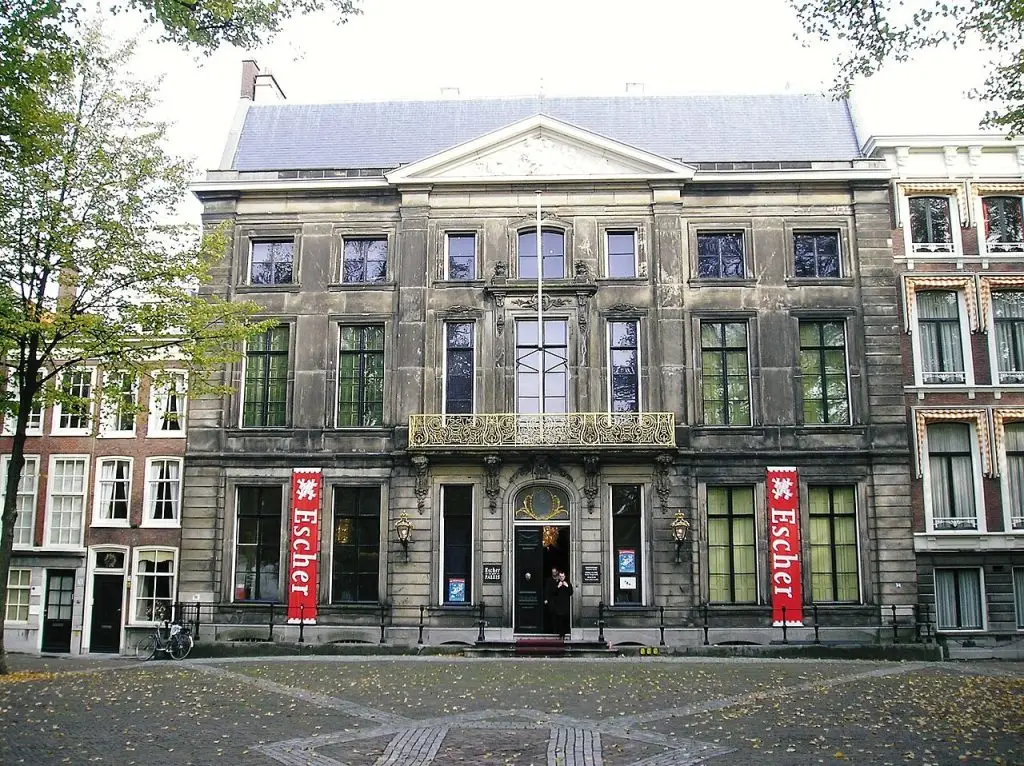
If you have ever seen a staircase that goes up forever or hands drawing each other, you know the work of M.C. Escher. The Escher Museum The Hague, officially called Escher in Het Paleis, is the best place to see his art up close, and it is surprisingly fun for all ages.
About Escher
Maurits Cornelis Escher was born in Leeuwarden in 1898 and became famous for prints and drawings featuring impossible structures, tessellations and mirrored worlds. He lived and worked in several countries, and his work later became very popular with scientists and mathematicians.
The building
The museum is housed in the Lange Voorhout Palace, a former winter residence of Queen Emma. The grand rooms add a lovely contrast to Escher’s playful designs. Chandeliers hang above modern illusions.
What you will see
- Original prints and drawings: famous works such as “Relativity” and “Day and Night”.
- Interactive rooms: an upside-down room, a hall of distortions and illusions you can step into.
- Digital displays: animations that show how the tessellations work.
- Early works: landscapes and portraits made before his famous style developed.
Tickets and opening hours
Buy tickets online where possible, as time slots can fill up on weekends and holidays. Check prices and hours on the museum’s website. The museum is usually closed on Mondays, but verify before you visit.
How long to allow
One and a half to two hours is enough for most visitors. Families often spend longer in the interactive rooms.
Visiting with children
Kids love the illusion rooms, and photos look great. Bring a camera and expect a bit of dizziness. The museum has a shop with puzzles and posters.
Combine it with other sights
The Hague is full of options. Walk to the Binnenhof, visit the Mauritshuis with Vermeer’s “Girl with a Pearl Earring”, or head to the beach at Scheveningen. Trains from Amsterdam take around 50 minutes, so this works as a day trip.
Escher in Het Paleis is a small but memorable museum, perfect if you like art with a puzzle in it. For more Dutch city ideas, browse invisionfree.com.
Featured image: Andrew Crump, via Wikimedia Commons (CC BY 2.0).