Most of what a camera satellite records is not interesting. Clouds, open ocean and empty desert fill a large share of the frames, and sending all of it to the ground uses scarce radio time. The idea behind AI on satellites is to let the spacecraft look at its own pictures and decide what is worth sending home.
It sounds like science fiction, but the logic is plain engineering. Move the thinking to where the data is born, and you save the most limited resource in the system: the link to Earth.
The bottleneck is the downlink
A satellite in low orbit passes over a ground station for only a few minutes at a time. In that window it must send down everything it has gathered, and sensors can collect far more than the radio can carry. Data piles up on board waiting for the next pass.

This is the same problem that engineers face with remote sensors on Earth, and the same remedy applies: process near the source. We described that approach on the ground in how edge-to-cloud data sync works. In orbit the constraint is just harsher, because there is no cable to fall back on.
Compression helps, but it only shrinks data. It cannot tell a flooded field from a dry one. A model running on board can, which is the difference between sending a gigabyte of pixels and sending a short message that says “river overflow detected here, at this time”.
What AI on satellites can actually do
The jobs where AI on satellites fits best are narrow and well defined.
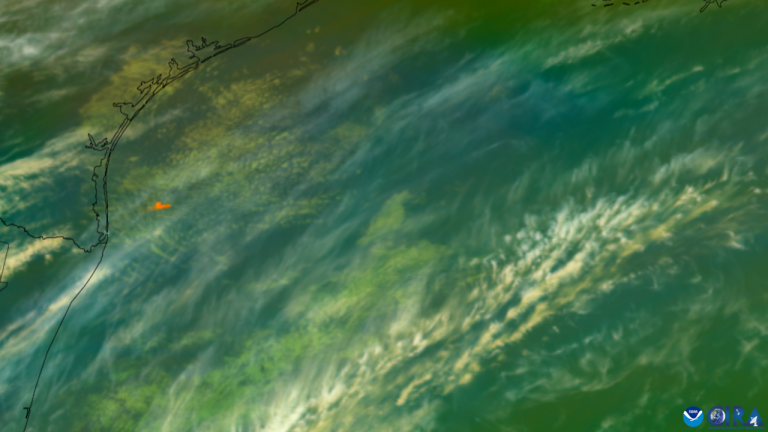
Filtering is the simplest. A model scores each image for cloud cover and discards the unusable ones. Detection comes next, such as spotting ships, wildfires or changes at a construction site, and sending only the relevant crop. Some spacecraft also use onboard software to decide where to point the sensor next, based on what it just saw.
Speed is the other advantage of AI on satellites. If a wildfire alert has to wait for the next ground pass, then for processing, then for review, hours pass. An alert generated in orbit can reach a responder far sooner. That matters for disasters, maritime safety and any field where a late answer is a poor answer.
The general idea is known as edge computing, and orbit is simply its most extreme location.
Why it is harder than it sounds
Space is a hostile place for the chips behind AI on satellites. Radiation can flip bits in memory and slowly damage circuits. Temperatures swing hard as the craft moves between sunlight and shadow. Power comes from solar panels and is tightly budgeted, and every watt that goes to a processor is a watt not available for something else.
That is why spacecraft have traditionally flown older, proven hardware instead of the newest chips. A modern accelerator that is brilliant in a data centre may not survive launch and years of radiation. Engineers handle this with shielding, error-correcting memory, redundancy, and sometimes by flying commercial parts for short missions and accepting the risk.
Updating is another headache for AI on satellites. A model on the ground can be retrained and replaced in an afternoon. A model in orbit must be uplinked, verified and swapped without bricking the satellite. Teams therefore tend to keep onboard models small, tested and conservative.
There is also the matter of trust. If a satellite discards images it judged uninteresting, a mistake means data is lost for good. Many designs keep a low-resolution copy or a log of what was dropped, so analysts can audit the model later.
Who benefits, and what to expect
The most obvious users are those who watch the planet: agriculture, forestry, insurers, shipping and emergency services. Cheaper launches have put many more small satellites into low orbit, and a crowd of small spacecraft makes the downlink problem worse, which pushes designers toward doing more on board. The same crowd is changing connectivity too, as covered in why airplane Wi-Fi is finally getting better.
For everyone else, AI on satellites will mostly be invisible. You will notice it as faster alerts, fresher maps and fewer gaps in coverage rather than as a product you buy.
It helps to keep expectations grounded. AI on satellites is not a floating data centre doing everything in space. Heavy training, long-term storage and detailed analysis will stay on the ground for the foreseeable future, where power and cooling are easy. Orbit gets the small, fast, selective tasks.
When you read an announcement about computing in space, a few questions cut through the excitement. What exactly runs on board, and what is still done on the ground? How large is the model, and how often can it be updated? What happens to the data it discards? And has the hardware flown before, or is it a first test?
Clear answers to those suggest a real engineering programme. Vague talk about “intelligence in the sky” usually does not. The honest pitch for AI on satellites is modest and useful: spend less radio time on empty pictures, and get the important ones to people sooner.