Here is the short answer to what is the definition of networth: it is the total value of your assets minus the total of your liabilities. If you own $500,000 of stuff and owe $200,000, your networth is $300,000. That is the whole idea, and the rest is just deciding what counts and how to value it.
The formula, step by step
Accountants call it the basic balance-sheet equation: assets minus liabilities equals equity. For a person, “equity” is simply your net worth. For a company it is shareholders’ equity. The math never changes, only the line items do.
- List everything you own that could be sold for cash.
- Put a realistic market value next to each item.
- List every debt, from the mortgage to the store card.
- Subtract the second total from the first.
The result can be positive, zero or negative. A negative number is common for recent graduates carrying student loans, and it is not a verdict on anyone’s future.
What counts as an asset?
Things that usually count
- Cash, checking and savings balances
- Retirement accounts such as 401(k)s and IRAs
- Brokerage accounts, stocks, bonds and funds
- Home equity (the home’s value, with the mortgage counted separately as a debt)
- Business ownership stakes
- Vehicles, valued at what they would realistically sell for
Things that are murky
Furniture, jewelry, art and collectibles technically have value, but they are hard to price and rarely sell for what you paid. Many people count only major items or apply a steep discount. Future earnings, Social Security and pensions are usually left out unless they have a clear lump-sum value.
What counts as a liability?
Anything you are legally obliged to pay back: mortgages, auto loans, student loans, credit card balances, personal loans, medical debt, and any tax you owe. Monthly bills that are not yet due, like next month’s rent, are normally treated as expenses rather than liabilities.
A worked example
| Item | Amount |
|---|---|
| Savings and checking | $18,000 |
| Retirement accounts | $72,000 |
| Home value | $340,000 |
| Car | $14,000 |
| Total assets | $444,000 |
| Mortgage balance | $255,000 |
| Car loan | $9,000 |
| Credit card | $3,000 |
| Total liabilities | $267,000 |
| Net worth | $177,000 |
These numbers are made up for illustration. Swap in your own and you have a personal snapshot in about fifteen minutes.
Net worth versus income
People mix these up constantly. Income is what flows in over a period, such as a salary. Net worth is a snapshot at a single moment. A doctor earning a high salary but carrying large loans and spending everything can have a lower net worth than a teacher who has saved steadily for decades. Wealth is about what you keep, not what you earn.
Why people track it
- It shows progress in a way a bank balance cannot, because it captures debt paydown and investment growth together.
- It makes trade-offs visible. Paying off a 24% card balance raises net worth as surely as earning the same amount in investments.
- It gives you a benchmark. The Federal Reserve’s Survey of Consumer Finances, last published in 2023 for 2022, put the median US household net worth at roughly $192,900 and the mean at roughly $1.06 million. The gap between those two figures tells you how much the very wealthy pull the average up. You can read the survey on the Federal Reserve’s SCF page.
Common mistakes
- Using a purchase price instead of market value. A car loses value the day you drive it home.
- Forgetting taxes on retirement money. Pre-tax account balances are not fully yours until the taxes are paid.
- Ignoring small debts. They add up and they are often the most expensive ones.
- Checking too often. Markets move daily. Quarterly is plenty for most households.
How often should you recalculate?
Once or twice a year is enough for most people, and a quarterly check works if you hold volatile investments. Use the same method each time so the comparison is fair. Keep a simple spreadsheet with dates in one column and the three totals, assets, liabilities and net worth, in the others. After a few years you will see a trend line, and that trend matters far more than any single reading.
What is the definition of networth for a household versus an individual?
For couples, you can calculate a joint figure, or each person’s separately. Joint figures are simpler when finances are shared, but separate ones help if one partner carries debt from before the relationship. Surveys such as the SCF measure households, so a joint number is the one that compares properly with published benchmarks. Children’s savings accounts and assets held in trust are generally left out unless you control them.
Liquid versus total net worth
Some planners also track “liquid net worth,” meaning cash and investments you could access quickly, without home equity or retirement accounts that carry penalties. It is useful for checking whether you could handle a surprise expense without borrowing.
The definition for companies and celebrities
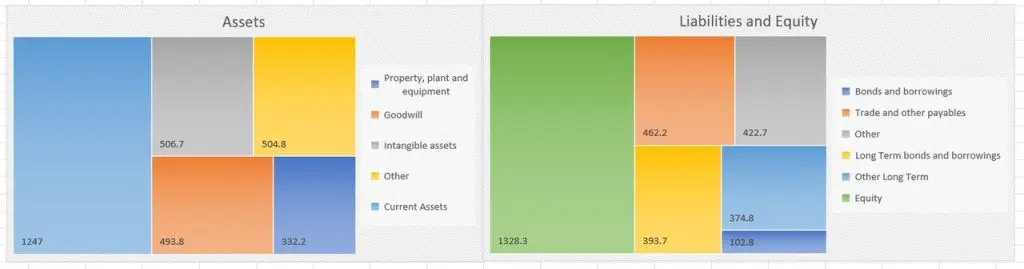
When a magazine publishes a celebrity’s estimated net worth, it is using the same definition, just with guesswork: public stock holdings, property records, reported deals, less estimated debts and taxes. Those numbers are estimates, not audited statements. For companies, you can find the real figure on the balance sheet in annual filings, labeled as total equity.
So, the definition of networth in one line
Once more, for anyone skimming: what is the definition of networth? What you own minus what you owe, measured at a point in time. For a deeper explainer on the terms, Investopedia’s net worth entry is a solid reference.
This is general information, not financial advice.
Related reading
- What Is Justin Timberlakes Networth? Pop Star Wealth, Explained
- What Is the Meaning of Networth? A Plain-English Explanation
Photo: Moochieboy74, CC0, via Wikimedia Commons


