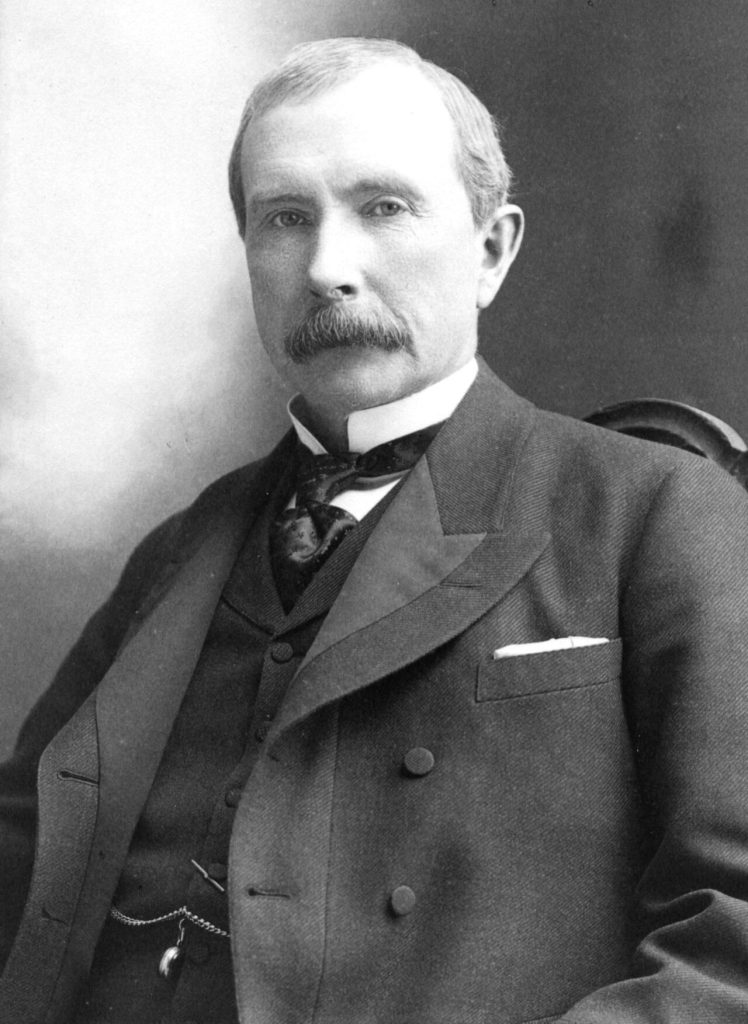
Converting a historical fortune into modern money is tricky, but here is the common answer. John d rockefeller networth today is often quoted at somewhere above $300 billion, and sometimes higher, when his peak wealth around 1913 is adjusted for inflation or measured as a share of the US economy. He is widely regarded as the richest American in history, and often described as the wealthiest person of the modern era.
Since we’re working with numbers from over a century ago, it’s best to explain how those comparisons are made, and why the answer swings depending on the method.
John d rockefeller networth today starts with the man and the business
John Davison Rockefeller was born in 1839 and entered the oil business in Cleveland, Ohio, in the early 1860s. In 1870 he and partners formed Standard Oil. Through acquisitions, efficient refining, and favourable shipping rates with railroads, the company came to control a very large share of US oil refining, with estimates often cited at around 90 percent at its height.
That dominance drew political and legal pressure. In 1911 the US Supreme Court ordered Standard Oil broken into dozens of separate companies under antitrust law. Several of its successors later became well-known firms. Rockefeller’s shares in the pieces rose in value, which, according to historians, pushed his fortune higher than before the breakup.
Three ways to compare his wealth to today’s
1. Adjusting for inflation
This is the simplest method. Estimates of his peak wealth at about 900 million dollars to roughly a billion and a half dollars, based on early twentieth-century accounts, are multiplied by a price index. Depending on the index, that produces results in the low hundreds of billions of today’s dollars.
2. Share of the economy
Some economists argue that raw inflation understates his position, because the US economy has grown so much. If his fortune was a bit under two percent of national output at its peak, as frequently cited, then the equivalent share of today’s economy would be far larger, into the high hundreds of billions or beyond. That’s a point where researchers disagree.
3. Relative to the richest people today
Compared with modern billionaires listed on Forbes and Bloomberg, Rockefeller’s inflation-adjusted figure would place him near or above the very top, but it doesn’t sit neatly in the ranking because the methods differ. This is why sources can reasonably give answers that are far apart.
What did he do with the money?
- Education: He funded the founding of the University of Chicago in 1890 and supported many schools, including historically Black colleges and women’s education in the South.
- Medicine: The Rockefeller Institute for Medical Research was founded in 1901, and the foundation later supported public health campaigns.
- The Rockefeller Foundation: Established in 1913 to promote the well-being of humanity worldwide.
Historians say he gave away several hundred million dollars during his lifetime. He died on 23 May 1937, aged 97, and his descendants have continued to play a part in business, politics, and philanthropy.
Why historical figures are only estimates
Nobody in 1913 published a modern-style net worth. The figures we use come from tax records, company valuations, biographers, and journalists writing years later. Stock valuations of the Standard Oil successors can be traced, so his case is better documented than most, but there’s still real uncertainty. If you see a precise figure such as 341 billion dollars quoted for john d rockefeller networth today, understand that it depends on one specific inflation method and one assumed peak.
How to treat the headline
- Treat the answer as a range, not a point.
- Check which method was used: inflation or share of GDP.
- Look for sources that cite historical data, not just repeat each other.
For a detailed biography, see John D. Rockefeller on Wikipedia. We checked how it describes the era, and it supports the broad outline above.
Rockefeller compared with other historic fortunes
Other names often discussed alongside him include Andrew Carnegie, who sold his steel company in 1901 and then gave away most of his fortune, and Cornelius Vanderbilt, who built his wealth in shipping and railroads. Historians frequently note that Rockefeller’s wealth was unusual for its concentration in a single industry. Because it was built on oil, a commodity that powered lighting, then transport, his business had a huge reach across the whole economy.
That’s also why comparing him with a modern tech founder is rough. The sizes can be similar, but the economies are different, and so are the tax rules, the markets, and the way wealth is recorded.
This article is for general information only and is not financial advice.